di Eric Levitz
The United States has never been richer. In 2018, American households boasted a collective net worth of over $98 trillion. If that wealth were divided evenly across the U.S. population, every human being in our country would have roughly $298,000 to their name — and every family of four would be millionaires.
Few Americans feel entitled to full communism. But many do have trouble reconciling their nation’s unprecedented wealth with the increasing insecurity of middle-class life. In the 1960s, economists worried that 21st-century Americans would struggle to find purpose once economic progress turned full-time employment into an archaic chore practiced solely by the eccentric, like churning butter or collecting CDs. And yet, in 2019, middle-class Americans are working harder than ever. We were promised flying cars. Instead, we got 60-hour workweeks.
So, what went wrong? How did we miss the exit for fully automated comfort-plus capitalism?
This week, an excellent New York Times feature titled “The Middle-Class Crunch” shed some light onto these questions by dissecting the finances of four model middle-income families, and by illustrating the macroeconomic trends that undergird their disparate struggles.
After reading the Times’ report and other recent analyses of our postindustrial discontents, I’ve come to think that the decline of America’s middle class can be attributed to three distinct (though related) policy failures. Namely, the failures to sustain American labor’s bargaining power; to contain rent-seeking in the housing, health-care, and higher-education sectors; and to update (and expand) the social-welfare state for the 21st-century economy.
1) We let wages fall too damn low.
This one is the most familiar (and, as an explanation of middle-class decline, arguably tautological). Nevertheless, it’s worth briefly reviewing the grim facts about working-class wage stagnation in the U.S. and how it came to be. From 1948 to 1973, the median worker’s hourly compensation rose in tandem with productivity. Which is to say: As innovation enabled the U.S. economy to extract more value per hour from the typical worker’s labor, it also enabled that worker to secure a higher rate of compensation. In the disco era, America was 96.7 percent more productive than it had been in 1948, and the median American worker was 91.3 percent better paid than her postwar analogue.
But then, times changed. Between 1973 and 2013, America’s labor force became 74.4 percent more productive — but the median U.S. laborer’s paycheck grew just 9.2 percent fatter.

Chart: Economic Policy Institute
Get unlimited access to Intelligencer and everything else New YorkLEARN MORE »
On one level, it’s a bit unfair to describe this development as a policy failure, since it was at least partly intentional. Amid the stagflation crisis of the 1970s, a consensus formed among policymakers that the excessive bargaining power of American workers had broken the economy. Unionized laborers had secured compensation in excess of their marginal productivity, which had forced firms to raise prices, which had led those workers to demand further wage increases, which had led to further price hikes, which had led to even more excessive wage demands, in an inflationary spiral. Beyond taking a toll on price stability, the greed of our working class was also enabling foreign competitors to eat corporate America’s lunch. The New Deal bargain might have worked in an era when Japan and Western Europe lay in ruins and American capital reigned supreme. But with Japanese and German industry ascendant, the U.S. could no longer afford to coddle its proletariat. Thus, to get a handle on inflation, protect the U.S. dollar, and restore our firms’ global competitiveness, wages would have to go down. Or, as Federal Reserve chairman Paul Volcker put it in 1979, “The standard of living of the average American has to decline.” To that end, Volcker engineered a recession by raising interest rates to unprecedented heights. This policy had its intended effects; many a worker’s will and union were broken. Inflation was licked.
But Ronald Reagan’s election ensured that the war on workers would persist even after price stability was restored. His firing of the PATCO strikers signaled that Uncle Sam no longer frowned on union-busting. Corporate America kicked its class war into a higher gear. Over the ensuing decades, as automation and globalization reordered the U.S. economy — and shrank the heavily unionized manufacturing sector — policymakers in both parties did little to nothing to facilitate the expansion of collective bargaining into service industries. As a result, America’s unionization rate fell by more than half between 1980 and 2018. This development, combined with a monetary policy that continued to prioritize low inflation over full employment, largely explains the decline in labor’s share of productivity gains.
Some may reject this analysis on the grounds that the stagnation of middle-class wages in the U.S. is the result of ineluctable economic forces. After all, in recent decades, such stagnation has been ubiquitous throughout developed countries, despite their profoundly different policy environments and rates of unionization.
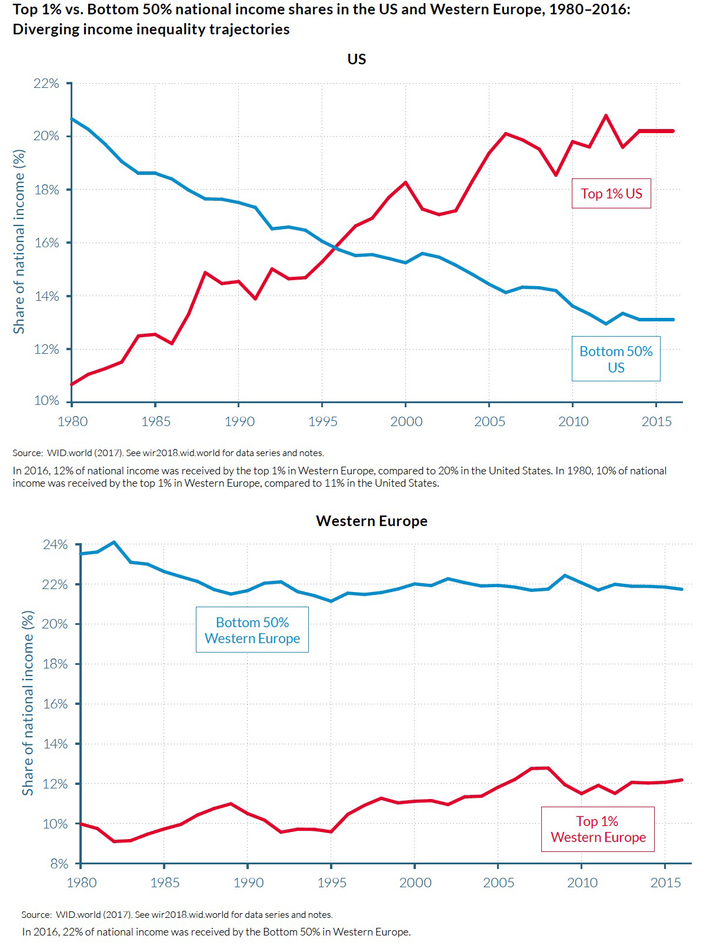
There are a lot of problems with this argument. But the most fundamental is that America’s workers have suffered a far greater setback than their Western European peers. Between 1995 and 2013, labor’s share of national income in the U.S. dropped by 8 percentage points, a steeper decline than in any other nation except for South Korea and Poland, according to a 2018 OECD report.
And the American capitalist class has been claiming an exceptionally high share of national income for much longer than just two decades — as this stunning chart from the 2018 World Inequality Report makes clear:
All this said, tepid wage gains are still wage gains. If eviscerating workers’ bargaining power had been our policymakers’ only sin, America’s contemporary middle class would enjoy more economic security than its predecessors. Unfortunately:
2) We let the costs of housing, health care, and higher education rise too damn high.
If you’re already growing tired of skimming this article — and are willing to settle for a partial understanding of the American middle class’s predicament — this chart from the “The Middle-Clash Crunch” will tell you 95 percent of what you need to know:
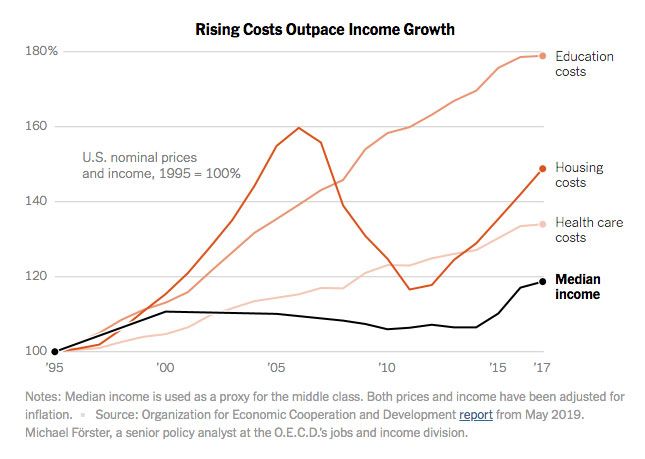
Chart: The New York Times
The neoliberal era has scored American households cheaper groceries and electronics. But it’s also enabled extractive interests in the health-care, housing, and higher-education sectors to bleed middle-income families dry.
The health-care industry may be our economy’s most ravenous parasite. Due to our central government’s exceptional refusal to combat rent-seeking in the medical sector through price controls, the United States spends several times more than similar nations on health-care administration, pharmaceuticals, and physicians’ salaries. In return, Americans enjoy the 29th best health-care system in the world (just behind the Czech Republic’s), according to The Lancet.

Source:: Source: Harvard T.H. Chan School of Public Health, Harvard Global Health Institute, London School of Economics. Credit: Rebecca Coleman/Harvard
To appreciate just how thoroughly we’re being ripped off, consider our neighbors to the north. In 2018, Canada spent roughly 11 percent of its GDP on health care, which was enough to provide all of its citizens with premium-free access to the world’s 14th-highest-performing health-care system. That same year, the United States spent roughly 18 percent of its GDP on health care — which, in our system, was not sufficient to provide any form of insurance to nearly 30 million Americans, nor to prevent more than 50 percent of our people from delaying or forgoing medical care due to affordability concerns.
A common misconception about the American political economy is that U.S. workers are lightly taxed. The Europeans may have a plusher safety net, the story goes, but at least we get to keep more of our take-home pay. But this is only true if one regards health insurance as a discretionary expense, which is not how the vast majority of adults in developed countries see it.
Continua la lettura su Intelligencer

Nessun commento:
Posta un commento